And to the angel of the church in Smyrna write:
The first and the last, who was dead, and has come to life, says this:
“I know your tribulation and your poverty (but you are rich), and the slander by those who say they are Jews, and are not, but are a synagogue of Satan. Do not fear what you are about to suffer. Behold, the devil is about to throw some of you into prison, so that you will be tested, and you will have tribulation for ten days. Be faithful until death, and I will give you the crown of life. The one who has an ear, let him hear what the Spirit says to the churches. The one who overcomes will not be hurt by the second death.” (Rev 2:8-11 NASB)
As I stated in the previous post, the “angel of the church” is the overseer, or pastor of the church. These messages are not designed to be read by the pastor, only. It is the duty of the pastor to bring the truth of God’s word to the congregation.
In this message, Jesus identifies Himself as, “The first and the last, who was dead, and has come to life”. When reading this, the first century Christian would make a connection to scriptures like:
This is what the Lord, the King of Israel and its Redeemer, the Lord of Hosts, says:
I am the first and I am the last.
There is no God but Me. (Isa. 44:6 HCSB)
There are several other passages in Isaiah that this saying points to (see Isa.41:4, 48:12). It also sets up the statement made in Rev. 22:13, “I am the Alpha and the Omega, the first and the last, the beginning and the end.”
The Christians in Smyrna faced persecution for their beliefs. When Christ says, “I know your tribulation and your poverty”, He is commending them for standing firm in the face of these tribulations. If their faith, love, and work for the Lord crumbled under the weight of persecution and trials, then then trials would have stopped, and there would be no church to write to. However, they stood strong in the face of adversity.
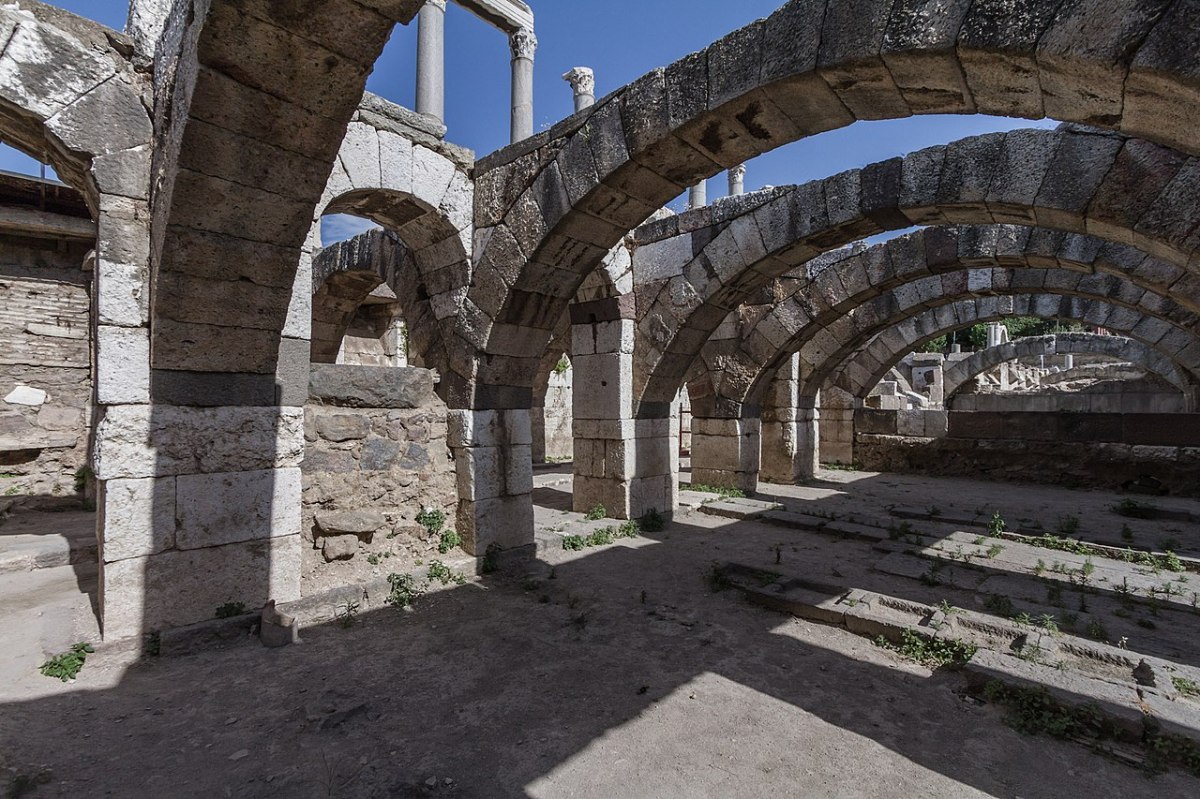
Smyrna was known for its temples to Zeus and the goddess Cybele. As a Christian church in the middle of this pagan activity, they were persecuted for their beliefs. This persecution affected their jobs and left them in poverty. However, Jesus says that despite their poverty, they are rich. They were rich in His blessing.
For there is no distinction between Jew and Greek; for the same Lord is Lord of all, abounding in riches for all who call on Him; for “Everyone who calls on the name of the Lord will be saved.” (Rom. 10:12-13 ESV)
Blessed be the God and Father of our Lord Jesus Christ, who has blessed us with every spiritual blessing in the heavenly places in Christ (Eph. 1:3 NASB)
They were further persecuted by the Jews, who rejected Christ. John says that the Jews, who at one point were God’s people, were now the “synagogue of Satan”.
Jesus then rebukes them for their fear. Rebuke may be a harsh word for what is said. The scripture says, “Do not fear what you are about to suffer.” The church was already under heavy persecution. That persecution led to fear. But Jesus tells them that they shouldn’t be afraid of what is to come. If they are already full of fear, and Jesus tells them not to be afraid, He is telling them to stop being afraid! Jesus then tells them that although they have been persecuted, more is coming. The “10 days” of tribulation here is not to be read as 10 days. This number shows that although the persecution lasts for a period of time, it is not a long time. Trials and tribulations for 10 days may seem like an eternity; however, they will end.
Jesus says to “Be faithful until death, and I will give you the crown of life.” To be faithful means to not allow the persecution to overcome them. They should continue trusting God, and not bow to the pressures of the persecution, even if it leads to death. The reward for faithfulness is “the crown of life”.
In ancient times, whenever someone was victorious in competition, a laurel was placed wreath on their heads. This was a public display where a person is declared a winner. That is exactly what Jesus is doing. He is declaring the faithful ones victorious after their death. Then He modifies that crown by calling it a crown of life. In the opening of this message, Jesus gives His qualification for awarding the crown of life. He identifies Himself as, “The first and the last, who was dead, and has come to life”. Jesus was persecuted to the point of death, yet He rose again as the one victorious. The crown of life is His to give.
The familiar phrase, “The one who has an ear, let him hear what the Spirit says to the churches” is once again stated in this message. As I said before, this phrase shows that this message is intended for everyone, from the day it was written until the day persecution no longer exists.
This message is concluded with a reward for the overcomers, “The one who overcomes will not be hurt by the second death.” So, what is this “second death”? The answer is given later in Revelation:
But as for the cowardly, the faithless, the detestable, as for murderers, the sexually immoral, sorcerers, idolaters, and all liars, their portion will be in the lake that burns with fire and sulfur, which is the second death. (Rev. 21:8 ESV)
So, “second death” = “lake of fire”. The overcomer, the victorious, the conqueror, will not be hurt by the lake of fire. This is not to say that they will experience the lake of fire and not feel the effects. No, this means that they will not experience the lake of fire. However, the opposite is also implied. The one who does not overcome will be hurt by the second death.
Persecution comes in many forms. Every Christian faces some degree of persecution in their life. How you handle that persecution shows your faithfulness to Jesus. When persecution comes, realize that no one faced any persecution greater than Christ. He lives today and offers a victor’s crown to those who overcome their trials.
 Todd's Blog